Home » Betty Biegel
 [ Welkom ] [ Het waarom ] [ Examens ] [ Morse sectie ] [ QTH Locator ] [ Lijsten / Tabellen ] [ Documenten ] [ Link Sectie ]

Betty Biegel (1886–1943) and the origins of the Farnsworth/Koch method.
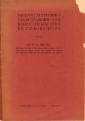 A number of years ago, in a small bookshop, I found a booklet from 1939: New methods for training radio telegraphists and telegraphists, written by Dr. R.A. Biegel.
Dr. Rebekka "Betty" Biegel (1886–1943), one of the first women in Dutch psychotechnics. In the 1930s she developed a method for teaching Morse code to radio telegraphists for the PTT: the characters were presented at full target speed from the very start, with only the pauses between the characters being lengthened and then gradually shortened.
That principle is known today as the Farnsworth method. This research — and the article that grew out of it — shows that Biegel published this idea as early as 1932, years before it found its way into the English-language technical literature via Koch (1936) and the American D.W. Taylor, a psychologist who worked on Morse learning methods (1943). Taylor even mentioned Biegel by name, though he mistakenly referred to her as "he."
Betty Biegel, a Jewish woman, on 26 May 1943, taken to Westerbork transit camp. There, on 1 June 1943, she and her sister Annie chose to die when deportation to Sobibor proved inevitable. As a woman in a male-dominated field, her name fell into obscurity. This article seeks to make her contribution visible again — as accurately as possible and with traceable sources.
Betty Biegel, her life and significance for morse
Dutch (original)
German translation
English translation
Source articles (PDF):
1931 – Eignungsprüfung (German, original)
1931 – Aptitude test (Dutch translation)
1931 – Aptitude test (English translation)
1932 – Anlernen (German, original)
1932 – Training aural reception (English translation)
1932 – Training aural reception (Dutch translation)
1939 – New methods (original)
1939 – Neue Methoden (German translation)
1939 – New methods (English translation)
How these documents came about
Starting from that one booklet from 1939, I began to follow her trail. Through archives, parliamentary records (Staten-Generaal Digitaal), and the register of the War Graves Foundation (Oorlogsgravenstichting), I reconstructed her life, and online I found her original articles from 1931 and 1932.
I translated the German texts into Dutch, and the 1939 booklet into English and German, so that her work also becomes accessible internationally. In translating, organizing, and checking the sources, I made use of AI, tracing every claim back to a findable source. Biegel's work has been free of copyright since 1 January 2014 (70 years after her death, Copyright Act art. 37), so these documents may be freely shared.
[ Updates ] [ Disclaimer ] [ Copyrights ] [ PA4TON ] [ Website ] [ Referenties ] [ Cookies ] [ Contact ]
© 2026 pe1hvh


© 2026 pe1hvh